
Custom business software built around the way you work
Custom ERP, CRM and operations systems for Australian small and medium businesses. We design and build private systems, you own the full source code.
Step 01 of 05
Discovery and scope
We learn how the work is being done now, including the manual steps and workarounds that have built up over time.
11
Years in operation
80+
Systems delivered
200+
Users supported daily
6
Countries with our software
Common problems we help solve
Most clients contact us because the systems that once worked for them have become difficult to manage as the business has grown. It is usually not one large failure. It is a collection of spreadsheets, manual steps and disconnected systems that take too much time and create too many opportunities for mistakes.
Important information is held in one spreadsheet
Pricing, stock or production planning may depend on a spreadsheet that only one person fully understands. That makes everyday work harder and creates a real risk when that person is away.
The same information is entered more than once
An order arrives by email, is entered into a spreadsheet and then entered again into the accounting system. The extra work takes time and increases the chance of an error.
Reports take days to prepare
Someone spends the first few days of every month combining information from different systems. By the time the report is ready, the information is already out of date.
Software costs keep increasing
You may be paying for a large system when your team only uses a small part of it, while the functions you actually need still sit outside it.
We use a standard User Interface (UI) which makes the User eXperience (UX) predictable and easy to learn.
Plain, predictable and the same from one client to the next. A list on the left, a record on the right, the actions you are allowed to take and nothing else. New staff learn it in a morning.
Underneath, every one of these runs a different business: a hardware wholesaler in Auburn, a food importer trading in two languages, a bookseller with four sites and a 3PL, a publisher's catalogue. Off the shelf software makes you run your business its way. It is 2026 and there is no reason to accept that. Tell us how you work and we build around it. If you want the workflow improved, we will tell you where.
Bookseller, four sites and a 3PL
Start of day
Work queues are counts, not colours. You open one and work it. Promises at risk and the express cutoff sit at the top because that is what the morning is about.
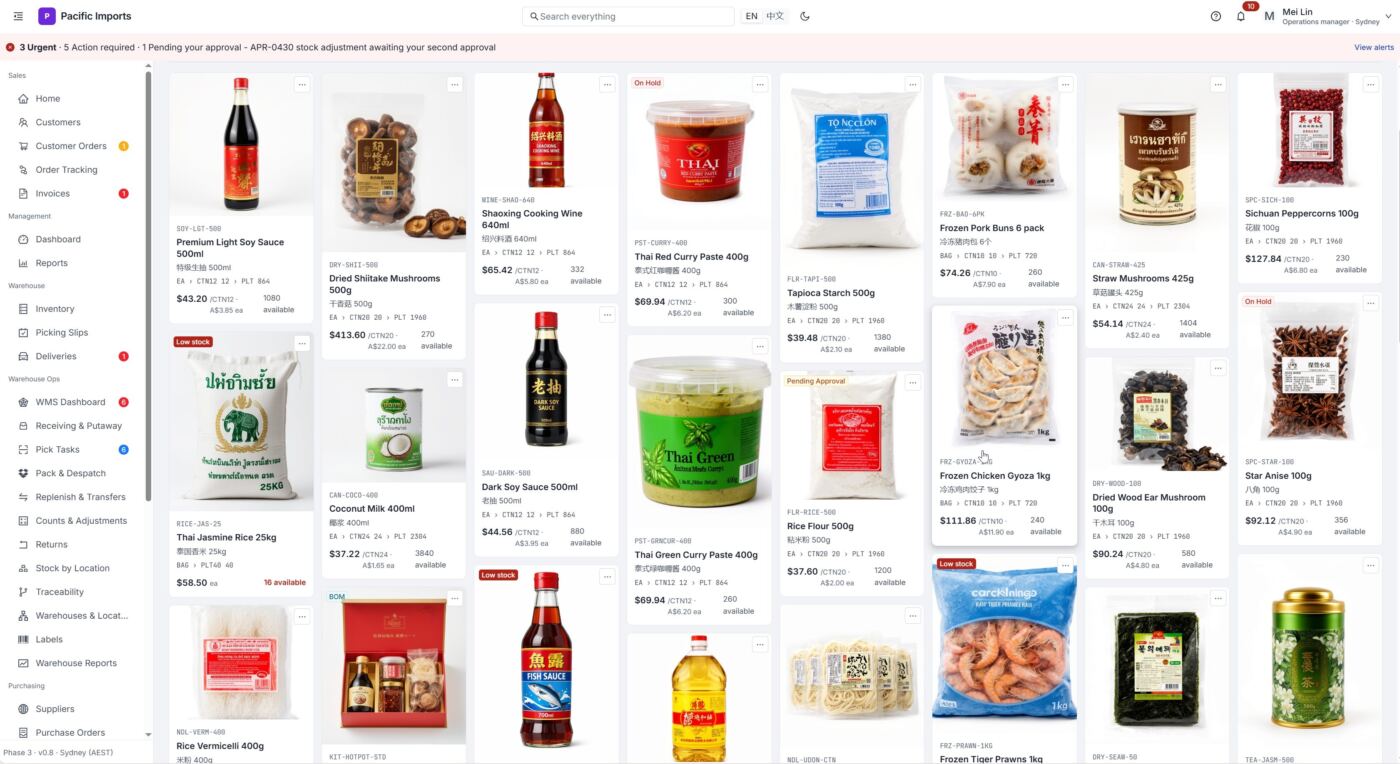
Food importer, Sydney
Product master
English and Chinese names on every product, carton and pallet quantities beside the unit price, and the stock position in the corner of each card.
Food importer, Sydney
Two-person approval
A stock adjustment shown as a field level diff. The approved record stays live until two different people sign, and editing the proposal restarts the count.
Hardware wholesaler, Auburn
Product gallery
939 products filtered by kind, finish and supplier. Photos appear where the team has taken them and a plain placeholder where they have not.
Hardware wholesaler, Auburn
The same screen in Chinese
One click in the header switches the interface language for that user. There is no second system and no separate login.
Publishing catalogue
Catalogue dashboard
Built on the ONIX publishing standard. Review queue, lowest confidence matches and unmapped subject codes on one screen, so a person sees only what needs a person.
Food importer, Sydney
A pick on the warehouse floor
Location and product barcodes to confirm the pick, and the alternative stock in first expiry order if the bay comes up short.
Food importer, Sydney
Location labels
Printed for the racking from the same data. Code 39 barcode and a check digit on every label, with the minimum and target quantity for the bay.
Food importer, Sydney
Support tickets as a board
Customer, internal and supplier issues in one queue, with an SLA timer by priority and a link to the record each one concerns.
Food importer, Sydney
Audit log
Append only. Every action, the user, their IP address and the fields that changed, in Sydney time. Reading this log is its own permission.
Customer portal
The customer's view
Open orders, account balance, deliveries in transit and a reorder button, on the phone the customer already carries.
Food importer, Sydney
Purchase order in the supplier's currency
Yuan on the order, the AUD equivalent beside it. An ETA change is logged, shown in the activity feed and raises an alert for the buyer.
Bookseller, four sites and a 3PL
Catalogue and stock
Cover, format, what is on hand and what is incoming, at a glance. Out of stock and sourcing states are on the card, not in a report.
Food importer, Sydney
Permissions as a matrix
One row per module, one column per action. Approve level 1 and level 2 are separate so two-person approval can be enforced.
Food importer, Sydney
Lot and expiry trace
From supplier receipt through every movement to the customer delivery. A lot hold blocks that stock in every location and warehouse at once.
Publishing catalogue
Every AI run recorded
Which model and prompt version answered, what it cost and what it produced. Nothing the AI suggests is applied until a person approves it.
What we build
We build several types of business systems, but the starting point is always the same: understand the current processes first, then choose the right way to solve it. We work with cutting edge software libraries and frameworks and will recommend the platform that best suits the users, workflow and expected life of the system.
2
We have 2 main platforms, selected to suit the project. Filemaker or Laravel
0
No per-user licence payable to X2 Network
100%
You own 100% of the source code we produce for your system
One system, built for your business
Custom business applications
The flagship. A custom application brings the important parts of your daily operations into one system. We map the way your team works, then build a system that supports it without relying on undocumented steps or individual memory.
- Replace important spreadsheets and disconnected tools
- Give staff access to the same up-to-date information
- Support the parts of your process that standard software does not handle well
- Add new modules as the business grows and changes
Quoting through to dispatch, in stages
ERP and operations systems
For businesses comparing NetSuite, MYOB Advanced, Cin7, Salesforce, Odoo or similar ERP products, a custom operations system may also be worth considering. We deliver it in stages so each part can be used and assessed before the next is built. Plus our pricing is fair and reasonable even though its a fraction of the cost of the large multi-nationals
- Purchasing, inventory, production, dispatch and job costing
- Current stock information across multiple warehouses
- Integration with your existing accounting system
- No per-user licence payable to X2 Network
Including systems somebody else left behind
Craft Theme the FileMaker development framework
New builds, version upgrades, server migrations and performance work. We also take on inherited systems: the ones built years ago by a developer who has since moved on, where nobody currently knows how it works or whether it is safe.
- Fixed price system review with a written report
- Modernisation of older and inherited FileMaker systems
- Audit logging, approvals and a security layer as standard
- A consistent architecture based on our Crafty Framework
When the users are outside your business
Web applications and portals
Some things do not belong in an internal system. When customers, stockists or suppliers need to place orders, check stock or download statements themselves, we build it in Laravel so it runs in any browser with no licence per user.
- Stockist and wholesale ordering portals
- Supplier portals for purchase order confirmation
- Customer self service for statements and tracking
- Unlimited users, because there is no per seat cost
Stop typing the same thing twice
Integrations and automation
Often the fastest thing we can do for a business, and usually the cheapest. Two systems that already hold the right information but do not speak to each other, connected properly, with error handling rather than hope.
- Xero, MYOB and QuickBooks
- Shopify, WooCommerce and marketplaces
- Freight carriers and 3PL warehouses
- Payment gateways, email and document systems
What happens after go live
Support and ongoing development
The question most people forget to ask a small team until it matters. Support plans have published response commitments, change requests are quoted before any work starts, and there is always a named developer who knows your system.
- Three plan tiers with published response times
- Hosting, backups and monitoring included
- Change requests quoted before work begins
- Source code escrow available on request
Not sure which of these you need?
Most clients arrive describing a problem rather than a product. Working out which of these is the right answer, or whether the answer is none of them, is what discovery is for.
Wholesale distribution, Sydney, 38 staff
CASE STUDY
Inventory and purchasing system for a wholesale distributor Three spreadsheets and an accounting package replaced by one system covering purchasing, stock on hand and allocation across two warehouses.
3 days to 4 hours
Monthly stock reconciliation
Same day
Stock figures now available to sales, previously next day
An experienced team throughout the project
The developers involved in discovery remain involved during design and development, while our office team keeps scheduling, communication and project administration organised.
Direct access
You have the developer's phone number. Questions are answered in one conversation rather than three.
You own it
Source code, data, documentation and the specification. All of it, with no licence tying you to us.
Delivered in stages
Each phase goes live on its own and is paid for on its own. There is no single day on which everything must work.
Prices published
Indicative bands are on the pricing page. You can work out roughly what this costs before you speak to us.
How we work
We plan and deliver projects in stages. You can review the work and decide whether to continue at the end of each stage. Everything completed and paid for up to that point belongs to you.
Discovery and scope
We meet with the people who use the current process and document how the work is really being done. You receive a written specification, a delivery plan and a fixed price for the first build stage.
Design and prototype
We create a working prototype of the main screens and review it with your team. This gives people a chance to test the proposed workflow before development begins.
Build in phases
The project is divided into useful stages, usually based on a department or part of the workflow. Each stage is tested, delivered and paid for separately.
Go live and training
We migrate your data, train staff using their real day-to-day tasks and stay available while everyone becomes familiar with the new system.
Support and improve
After launch, we can continue to support the system and add improvements as your business changes. Support commitments are published and changes are quoted before work begins.
Price guide
We publish our usual price ranges so you can see whether we are likely to be a good fit before spending time on a call. The final price depends on the scope agreed during discovery and is set out before development starts.
Book a discovery call
Thirty minutes with the person who would build your system. We will ask about how your business runs today, where the manual work sits, and what you have already tried. You will leave with a view on whether custom software is worth it for you, and a rough range for what it would cost. There is no charge and no obligation.
Or call 02 9100 0168 during business hours.